


Why I talk about everything but the Alcázar
When I guide in the Alcázar, I seem to talk about everything except the Alcázar. This is, of course, an exaggeration. Or not, really.
But I do try to avoid exact dates, and I am unlikely to spend much time telling you whether an arch is horseshoe-shaped or polylobed. And although plenty of kings have left their mark on the Alcázar over the centuries, I have no intention of introducing you to every single one of them. Not even half! I know this information; I simply don't think that knowing those facts necessarily translates into understanding a place better.
Sometimes the best moments have very little to do with what I had planned to explain at all. Years ago in Paris, I had a guide who was visibly pregnant. At one point, she read us a letter Marie Antoinette had written to her children from prison, and halfway through, she had to stop and wipe her eyes. In that moment, Marie Antoinette stopped being a name in a history book and became a woman terrified she'd never see her children again. The guide simply connected so deeply with that emotion that everyone in the group felt moved. I don't remember a single other thing from that tour, but I remember THAT.
That's why, when I prepare a visit, I think of an emotion first. And from there, everything starts pulling in the same direction: the tilework, the courtyards, the ceilings. I have always been much more interested in why people did things than in memorising when they did them. For instance, why Pedro I, a Christian king in fourteenth-century Castile, surrounded himself with an Islamic aesthetic and called himself Sultan. I am interested — and I hope my audience is too — in what that tells us about prestige, politics and identity in medieval Spain, because the reality is far more complicated than the romantic simplification I often read in guidebooks.
This is where, for me, a monument starts to become interesting. Historic buildings do not exist separately from the people who built them, used them and inherited them. And the past does not sit neatly behind us either. Much of it is still there, hidden in the way a city behaves, so no wonder I end up talking about why we speak and eat the way we do while standing in a centuries-old palace.
Eventually, I promise, we will get back to the palace. Although, as far as I am concerned, we never really left it ;-)
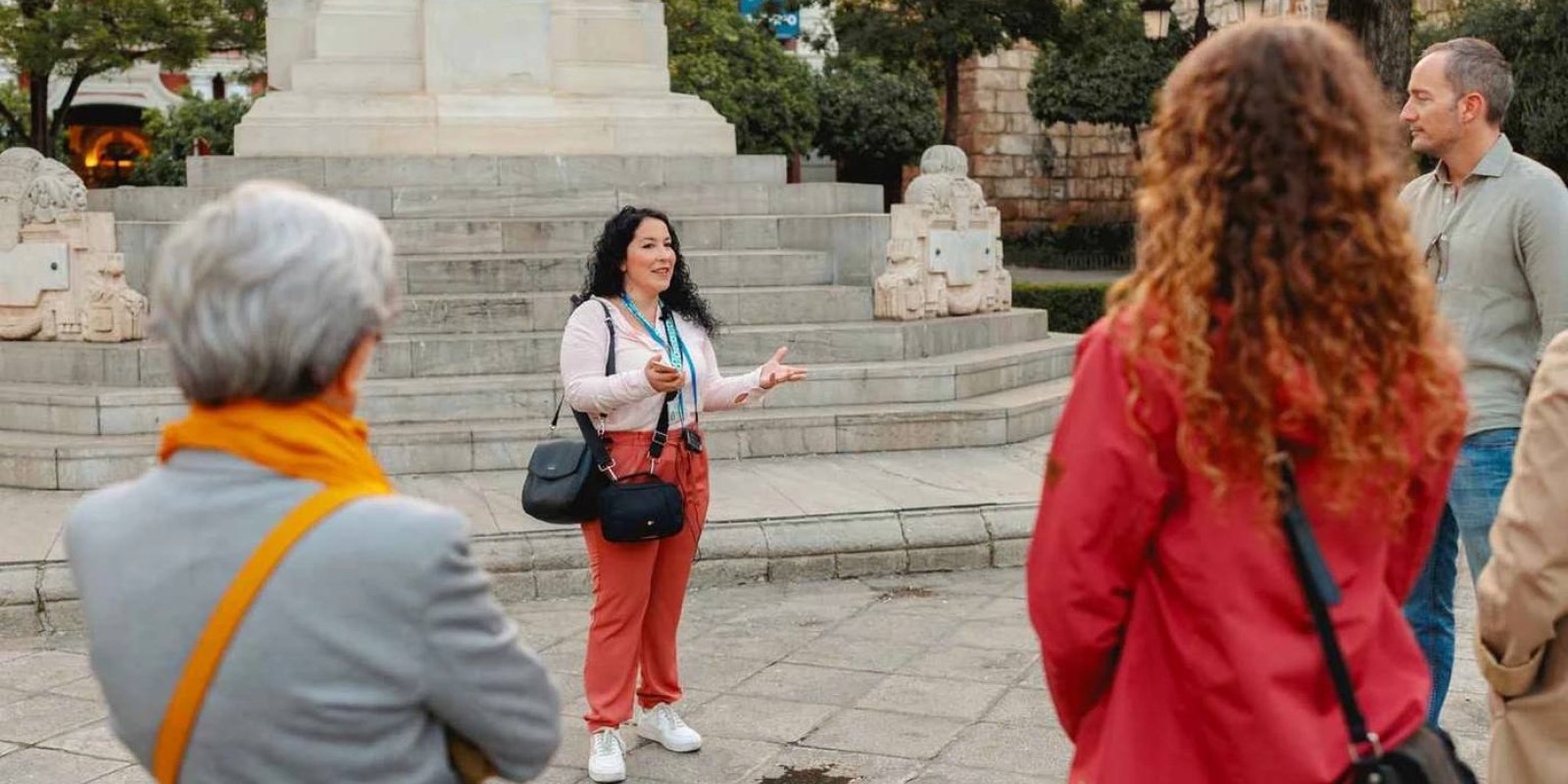
Photo: me guiding, property of WalksDevour